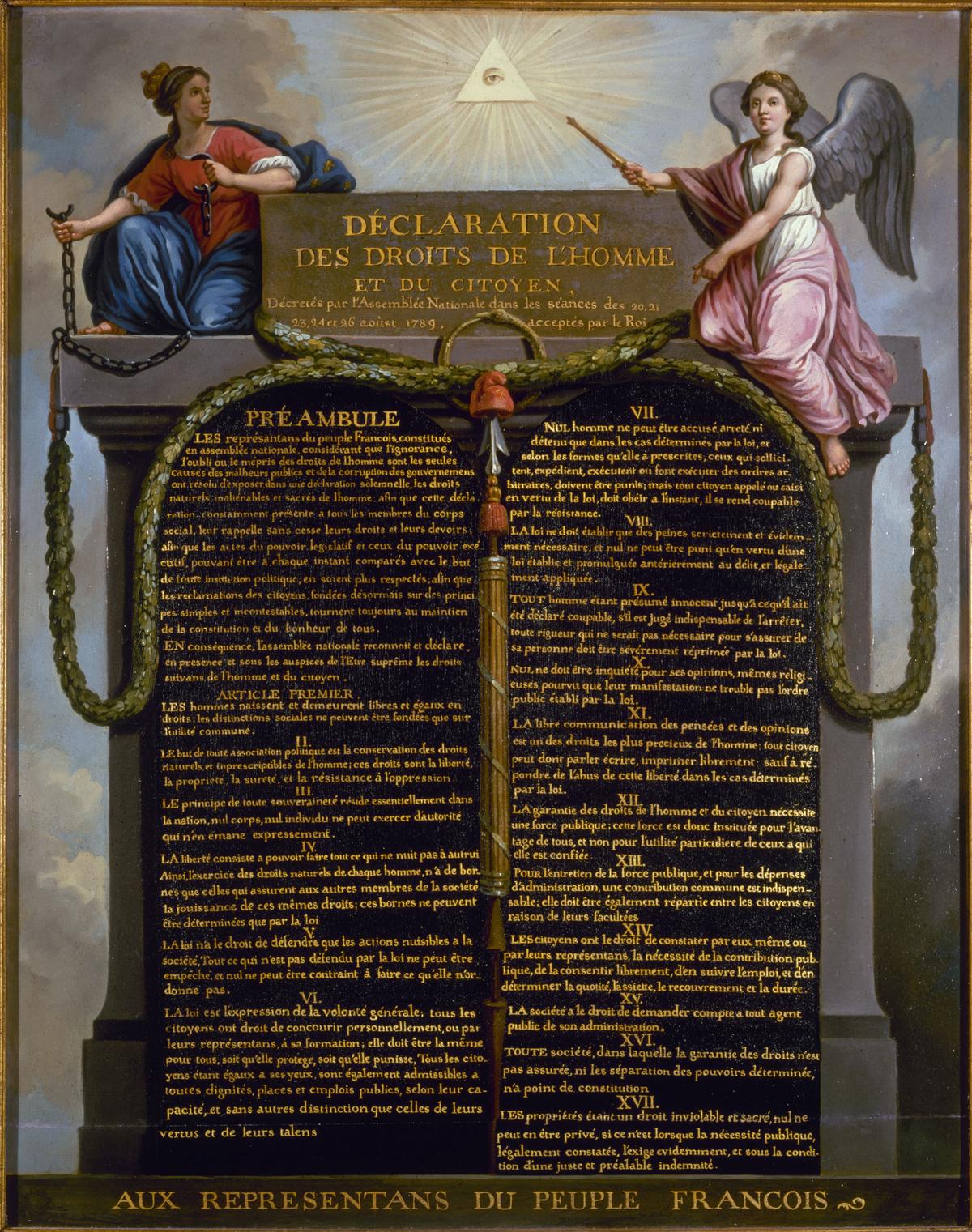
On August 26, 1789, the National Assembly issued one of history's most influential documents: the Declaration of the Rights of Man and of the Citizen. In seventeen articles it dismantled the Old Regime and proclaimed a new vision of human freedom that still resonates today.
A New Philosophy of Government
The Declaration's authors drew on Enlightenment thinkers like Locke, Rousseau, and Montesquieu, and were directly inspired by the American Declaration of Independence of 1776. But where the American declaration focused on separation from a colonial power, the French Declaration was a statement of universal principles — a claim about the natural rights of all human beings everywhere.
The Core Principles
Article One declared: "Men are born and remain free and equal in rights." Article Three declared that "the principle of all sovereignty resides essentially in the nation." Other articles guaranteed freedom of speech, freedom of the press, freedom of religion, the presumption of innocence, and protection from arbitrary arrest.
"The principle of all sovereignty resides essentially in the nation. No body nor individual may exercise any authority which does not proceed directly from the nation."
— Declaration of the Rights of Man, Article 3, 1789What It Left Out
The Declaration said "Man" — and meant it literally. Women were explicitly excluded. Olympe de Gouges responded in 1791 with her own Declaration of the Rights of Woman, demanding equal rights. The Assembly ignored it. De Gouges was executed in 1793.

A Document That Echoes
Despite its limitations, the Declaration became one of the foundational texts of modern democracy, inspiring independence movements and constitutional reforms across two centuries. In France it remains legally in force today — incorporated into the preamble of the 1958 constitution.